Agent session and diagnostics
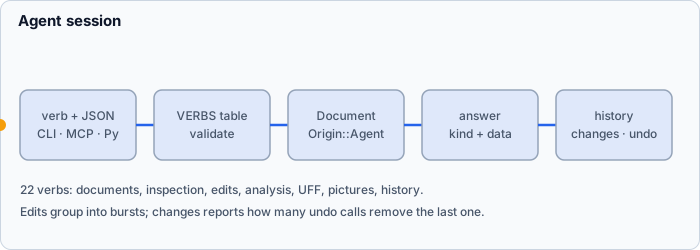
Reference: Crystal-Builder xtal/agent/ (MIT; capabilities.py 227 lines, session.py 1834, inspect.py 352, diagnostics.py 253, changes.py 197, answers.py 210, render.py 137). This page records how the port works and where it deliberately differs.
1. Problem
An AI assistant needs a small, stable vocabulary of operations over a document, answers it can print and pass on, and a machine-readable statement of what the installation can do. Two failure modes are worse than a missing feature: an assistant that quotes a capability the build does not have, and an assistant whose edits a user cannot review or undo as a unit.
2. Catalogue as data
verbs::VERBS is one static table. Each entry declares:
- the name the surfaces call;
- a one-line summary;
- the JSON type, required flag and default of every parameter;
- the answer kind;
- a complete JSON example;
- whether it mutates the document.
The table is compiled into the crate. The CLI, Python and WebAssembly surfaces read it; there is no second list. capabilities adds the facts that only a running installation knows: compiled features, external binaries that answer --version on PATH, embedded data bundles and the registered formats.
3. Session
A Session owns a map from name to Document. run(verb, arguments) does:
- verify the name is in the catalogue (
unknown_verb); - parse the arguments and report the first bad one (
invalid_argument); - resolve the document, falling back to the active one;
- call the operation;
- wrap the result in an
Answer.
Every mutation becomes a Command with Origin::Agent, applied through Document::apply; the session never edits a structure in place. This is what makes undo, history and changes see the assistant exactly like a person.
4. Diagnostics
diagnose(structure) expands the P1 cell once and runs six groups of checks (empty cell, overlaps, occupancy, charge, bonding, symmetry) that produce the nine codes below. Each finding has a stable code, a Severity (info, warning, error), a message, the atom indices and an optional verb that would fix it.
| Code | Severity | Rule |
|---|---|---|
empty_structure | error | no atoms in the P1 cell |
overlapping_atoms | error | periodic pair distance < 0.4 A |
partial_occupancy | info | any site occupancy < 0.999 |
charge_imbalance | warning | abs(total_charge) > 1e-6 e |
dangling_atoms | warning | non-metal atom with no perceived bond |
missing_hydrogens | info | C/N/O atom with fewer bonds than its valence |
unusual_coordination | warning | more than 12 bonds on one atom |
no_symmetry | info | P1 with more than three atoms |
symmetry_failed | info | the symmetry search did not finish |
The 0.4 A overlap threshold is the reference's; the valence table is H/D 1, C 4, N 4, O 2, halogens 1, S 6, P 5, B 4. The valence check is deliberately conservative: a carbon in a carbanion or a hypervalent sulfur produces an info, not an error. Symmetry findings are info because a deliberately asymmetric model is valid.
Findings are sorted by severity (error, warning, info) and then by code, so two runs on the same structure produce byte-identical reports.
5. Change bursts
The command log records (description, origin) per edit. changes_for walks the log and groups consecutive Origin::Agent records. A burst is (start, len, descriptions, undo_steps). undo_steps is Some(len) only when the burst ends the log, because an interleaved user edit makes a single undo insufficient. This is the reference behaviour, expressed over the typed log instead of a Python object.
6. Pictures
The renderer takes the scene data of Task 3.14.4 (atoms, bonds, cell edges, radii and colours) and projects it orthographically:
- camera direction
f, up hint; rightr = normalize(up x f)andu = normalize(f x r); - centre and half-extents of every visible sphere and cell edge in
(r, u); scale = min((W - 2m) / 2h_r, (H - 2m) / 2h_u);- screen
x = W/2 + (p - c).r * scale,y = H/2 - (p - c).u * scale, depth(p - c).f(larger is closer).
SVG writes the primitives sorted by depth, cell edges first. PNG rasterises with a depth buffer: sphere pixels take the near surface z + sqrt(R^2 - d^2); bond and cell segments take the interpolated depth along the segment. One fixed light shades spheres and capsules. The PNG encoder writes the signature, IHDR, one zlib-compressed IDAT and IEND; flate2 supplies deflate and the CRC-32 is computed locally. No C library, image crate or GPU is involved.
The reference uses VTK and off-screen rendering. This port is intentionally smaller: no transparency, no ambient occlusion, no text labels. It is good enough to see a folded linker, a missing cluster or a wrong cell.
7. Complexity
| Operation | Cost |
|---|---|
| Load and summary | one P1 expansion, O(N) |
| Diagnostics | O(N^2) periodic pairs plus one symmetry search |
| Supercell, wrap, hydrogens | one command, O(N) to O(N log N) |
| PXRD | O(reflections x profile) |
| Porosity | one grid of prod(ceil(L_i / s)) points |
| UFF energy | one model build plus the neighbour list |
| Render PNG | O(W H) plus the primitives' bounding boxes |
8. Validation
crates/xtalforge-agent/tests/verbs.rs: catalogue uniqueness, every example only names declared parameters, required parameters have no default.crates/xtalforge-agent/tests/session.rs: load/info/diagnostics on NaCl, unknown verb/document errors, supercell plus undo/redo plus change bursts, agent origin in the history, save round trip, Fm-3m detection, diamond six-rings, PXRD and porosity finiteness, UFF energy and a water optimization that does not raise the energy, close.crates/xtalforge-agent/tests/render.rs: SVG size and atom circles, PNG signature andIHDRdimensions, the no-visible-atom error, dimension checks and the CLI path.crates/xtalforge-wasm/tests/agent.rs: catalogue and capabilities JSON, a session that loads CIF text and answersinfo, and the coded unknown-verb error.
9. MCP transport
The server is a minimal JSON-RPC 2.0 implementation: newline-delimited messages on stdio, methods initialize, notifications/initialized, ping, tools/list, tools/call and notifications/cancelled, protocol version 2024-11-05. A full MCP crate was considered and rejected: the surface is one request/response pair per tool, the schema is generated from VERBS, and the message set fits in one file (Task 8.2.1 records the choice). Malformed JSON is -32700, an unknown method is -32601, a bad tools/call parameter is -32602, and a tool failure is a successful response with isError: true and the stable code in the text payload.
initialize carries instructions (Task 8.2.2), so a client that cannot read the skill files still learns the workflow, the answer shape and the limit behaviour.
10. Skill documents
Fourteen markdown files are embedded with include_str!: the main skill, the MCP setup, three worked prompts (MOF build, porosity report, deposited CIF) and nine references (API, calculations, carbon, diagnostics, MOF, polymer, porosity, preparation, workspace). xtalforge skill show prints one, install writes the tree, and the published form is the automation guide. The files are not generated at runtime: a release ships the text that was reviewed.
11. Safety
Every call runs in the session's standard Limits profile. The supercell check runs before the command allocates, the porosity grid check before the distance grid, and the render check before the raster buffer. A refusal is Error::LimitExceeded with the verdict's sentence.
Verbs are synchronous. notifications/cancelled is accepted but can only take effect between calls; the server cannot preempt a running verb without threads and a way to stop the native computation. A client that must interrupt a call terminates the xtalforge mcp process. This is a recorded deviation from the reference, which runs the same synchronous verbs in a Python process. Timeouts are therefore enforced by the size limits (bounded work) and by optimize's step limit, not by a wall-clock timer that would report a result the computation already produced.
The window proxy and discovery of Task 8.2.4 are out of scope: there is no window. The reference's mcp.json shape (url, pid) is documented in the automation guide for a future front end, but no code reads it.
12. Differences from Crystal-Builder
- The reference's window proxy and desktop discovery are out of scope; there is no window to proxy. The MCP transport is Task 8.2.
- Pictures use a small orthographic rasteriser instead of VTK; see section 6.
- The verb catalogue is shared with the bindings rather than generated from the CLI at runtime; both express the same operations.
- Diagnostics return atom indices in the P1 cell, not object identities.