Symmetry detection and the moyo backend
Isolation
moyo is used only inside xtalforge-symmetry::convert, dataset and spacegroup. The public API uses core SymOp, Lattice and Structure values, so replacing the backend does not change callers or bindings. The crate never exposes a moyo type.
Conversion
The lattice rows are the vectors a, b and c. moyo's Lattice::from_basis takes the same row convention and stores columns internally; the conversion uses it directly and a round trip is tested.
Positions are fractional column vectors. Atom types are (Z, occupancy) pairs rounded to three decimals and mapped to dense integers in first-appearance order. This is stricter than spglib, which types by atomic number only: a partially occupied site cannot become equivalent to a fully occupied one.
Detection
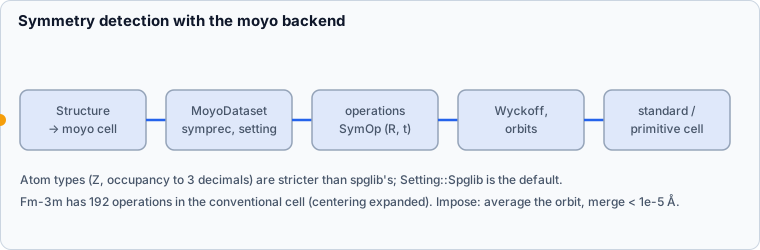
MoyoDataset::new(cell, symprec, angle_tolerance, setting, false) performs the iterative search, identifies the space group and standardizes the cell. The moyo operations are converted to SymOp, keeping exact integer rotations and fractional translations.
Setting::Spglib is the default because the golden data comes from spglib. The detected Hall number can differ from the file header when two origin choices are possible: Si is detected as Hall 525 (F 4d 2 3 -1d, origin choice 1) at symprec = 0.001, which matches the Crystal-Builder header.
Space-group operations
HallSymbol::traverse() returns one operation per rotation; the centering translations are expanded explicitly (base plus base * centering) to give the operations of the conventional cell. Fm-3m therefore has 192 operations, not 48.
Corpus exceptions
At the golden symprec = 0.001, the full corpus sweep matches the header group for every file except:
| File | Header | Detected | Reason |
|---|---|---|---|
CFA1.cif | 150 | 5 | coordinates are rounded to four decimals; 0.005 A recovers 150 |
cod/MIL-101.cif | 227 | 1 | disordered/partial framework; large-cell search needs a looser tolerance |
cod/MIL-100.cif | 227 | 1 | same as MIL-101 |
cod/PCN-222.cif | 191 | 177 | disordered metal sites lower the type symmetry |
cod/MIL-88B.cif | 190 | 40 | flexible framework with rounded coordinates |
edge/special_position.cif | 2 | 221 | synthetic edge case; the header is not the symmetry of the coordinates |
The occupancy part of the atom type also explains some lower groups. The list is intentionally explicit: a deviation is a documented tolerance or disorder effect, not silently accepted.
Setting a group
Reinterpret writes the current sites as the asymmetric unit of the requested group and attaches its operations; the P1 expansion may therefore create or merge atoms, which is the caller's responsibility.
Impose starts from the P1 cell. For every atom it applies every operation of the target group, matches each image to the atom within 0.5 Angstrom (minimum image), and averages the positions. The averaged positions are deduplicated by element and a 1e-5 A threshold. The report carries n_input, n_output and the largest displacement; a large displacement is a warning that the requested group is not a good description of the cell.
asymmetrize picks the first atom of each detected orbit and copies its label, occupancy, displacement parameters, charge, disorder group and props; to_p1 produces a plain P1 structure with unique labels.
Complexity
The search is moyo's iterative algorithm; it is not linear in the atom count for large disordered cells. The small-corpus test runs in seconds; the full sweep is #[ignore] and run manually before a release.
Band paths
The 14 Bravais entries and their special points come from ASE 3.29 (data/kpaths.json). A conventional cell alone cannot reveal centering, so band_path_for_structure uses the detected space group's Bravais class. The points are fractional reciprocal coordinates; multiplying by the user's reciprocal basis (with 2 pi) gives the Cartesian k axis, and the cumulative distance is the path abscissa.
Molecular point groups
The detector takes a non-collinear pair of atom vectors as a frame, maps it onto every pair with the same element pattern and both normal orientations, and keeps the rotations that permute the molecule. Proper rotations, mirrors and the inversion are counted and mapped to a Schoenflies symbol. The table covers the common crystallographic and molecular groups; linear molecules and groups outside the table are rejected.
Reduction
The structure-level reduction converts every P1 atom to Cartesian, then to the reduced lattice, wraps it and drops boundary duplicates. The row transform is the transpose of moyo's column transform; its determinant is +1 for a right-handed input. Volume and atom count are preserved by construction.
Brillouin zone
The zone is the intersection of the half-spaces G . x <= |G|^2 / 2 for the reciprocal vectors within the search box. A cube large enough for the most distant reciprocal vector is clipped face by face; each cut contributes a cap polygon ordered around the plane normal. The initial cube uses the longest vector, not the shortest, so anisotropic cells (a 20 Angstrom vacuum axis, for example) keep their hexagonal prism instead of collapsing to the c* box. Vertices and edges are deduplicated by distance. The fcc primitive cell yields the truncated octahedron (14 faces, 24 vertices, 36 edges). The structure entry point detects the primitive cell first, so conventional centred cells use the primitive Bravais lattice.
Tolerance ladder and diagnostics
The ladder runs the search at 1e-5 ... 0.5 A and groups consecutive samples with the same Hall number. Diagnostics compare each atom with the nearest image of every operation of the requested group; an atom already on the group gives zero deviation.
Subgroups
moyo enumerates the translationengleiche and klassengleiche classes from the primitive operations. The current wrapper exposes the representatives, their index, depth, operations and conjugate count. Naming each subgroup requires moyo identify on the subgroup operations in a reduced basis; that and the symmetry-lowering workflow are the remaining parts of Task 2.7.