Analysis: patterns, peaks, grids, surfaces and nets
This page covers the analysis operations that do not have a dedicated page: the calculated pattern, peak finding, the distance grid, isosurfaces, net merge/overlay, the Pareto front and the Zeo++ bridge. Powder refinement has its own pages (indexing, Pawley, Le Bail, Rietveld).
Calculated PXRD
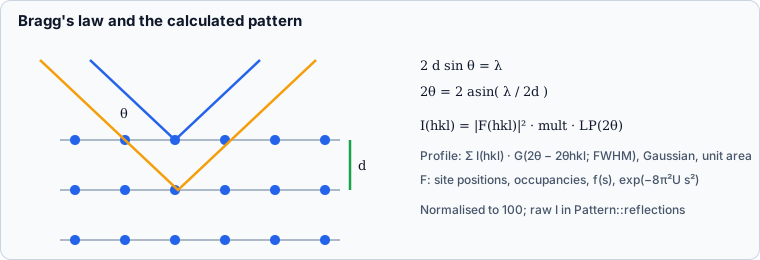
For every allowed reflection (hkl) with d-spacing d:
2 theta = 2 asin(lambda / (2 d))
I(hkl)  = |F(hkl)|^2 * multiplicity * LP(2 theta)
I(2 theta) = sum_hkl I(hkl) * G(2 theta - 2 theta_hkl; FWHM)
F is the structure factor from the site positions, occupancies and atomic scattering factors; LP is the Lorentz-polarisation factor; G is a normalised Gaussian. The pattern is sampled on a regular 2 theta grid. The answer is normalised to 100 in the API; the unnormalised reflection intensities are kept in Pattern::reflections.
Validation: the rutile pattern from Crystal-Builder/rietx and the NaCl calculated pattern (tests/golden/phase-7, corpus tests). The profile is a model, not an instrument: the FWHM is an input (one Gaussian of unit area, no Caglioti width) and no axial divergence or sample broadening is applied. An isotropic U_iso enters as exp(-8 pi^2 U s^2); anisotropic parameters and anomalous scattering are ignored.
The atomic scattering factors are the neutral-atom International Tables Vol. C (1992) Table 6.1.1.4 fit, f(s) = sum a_i exp(-b_i s^2) + c, embedded for H to Cf (crates/xtalforge-analysis/data/it92.json, generated by scripts/generate-it92-data.py). Heavier elements fall back to Z exp(-0.5 Z^(2/3) s^2). With these factors the relative integrated intensities of Si, NaCl, bcc Fe and rutile match an independent |F|^2 m LP calculation with gemmi's IT92 tables to 0.1 % (audit of 2026-11-11). Before that audit the Z-based Gaussian was used for every element and the relative intensities were off by up to 50 % (rutile (1 1 1) 28 % instead of 19 %).
Peaks
find_peaks reports local maxima above min_height and min_distance, with optional smoothing, SNIP background subtraction and a per-line fit; the defaults (min_height = 0, no smoothing, no background) report every maximum, so noisy data should use PeakOptions::noise_limited (background subtracted, lines above 1 % of the strongest and five times the noise); fit_peaks refines position, height, width and a background term. The peak list is the input to indexing. The algorithms are deterministic and do not use a random initialisation.
Distance grid
The cell is sampled with max(1, round(L_i / spacing)) points along each axis, so anisotropic cells get a similar resolution. For each sample the signed distance to the surface of the nearest atom is stored (centre distance - van der Waals radius, minimum image over the periodic images): negative inside an atom, zero on its surface. From the grid:
- accessible volume: count of samples whose stored distance is at least the probe radius, times the volume of one sample (converges from below, with a boundary-layer error of about one spacing);
- surface area: grid faces whose two ends have opposite sign (outside versus inside a van der Waals atom) times the face area. It is the voxelised area of the van der Waals surface, not of the probe-accessible boundary, and overestimates a smooth surface at coarse spacing;
- largest included diameter: twice the largest stored distance;
- pore-size bins: histogram of
2 * distanceat every free sample with a caller-supplied bin width (a geometric distribution, not a Zeo++ result).
Cost is prod(round(L_i / spacing)) * N_atoms: every sample is compared with every atom, which is exact but meant for small and medium cells. The grid refuses a size above the budget before allocation; the generic check_grid estimate uses the same rounding with a minimum of 8 points per axis. Validation: the CoRE MOF subset (HKUST-1 and ZIF-8) checks a bounded accessible fraction and a positive surface area; the reference values are in tests/external/core_mof/README.md.
Isosurfaces
isosurface runs marching tetrahedra (six tetrahedra per grid cell) over a periodic scalar grid; there are no ambiguous marching-cube cases. The four crossings of a 2-2 sign pattern are ordered around their quadrilateral, so neighbouring tetrahedra share the same diagonal and the surface is watertight; vertices are welded by fractional position and the periodic boundaries close by wraparound. TriangleMesh { vertices, triangles } holds Cartesian vertices and index triples; it stores no normals. Used by the gyroid/Schwarzite carbon builders.
Nets
quotient_graph reads a net from a CGD entry: nodes are fractional vertices, edges carry the lattice shift of their second endpoint. Contracting a crystal structure (metal clusters and linkers) into its net is not implemented, so identifying a framework needs its net as a CGD entry. fingerprint computes the coordination sequence and point symbol; RcsrIndex matches them against the embedded RCSR 2019-06-01 snapshot (2,931 entries). merge_nets unions two quotient graphs; overlay_net writes a display overlay; pareto_front keeps the non-dominated points of a set of candidates.
The RCSR match returns a unique name, an ambiguous set or the nearest candidates: a fingerprint can be shared, and the API says so instead of guessing.
Zeo++ bridge
write_zeo_inputs writes the CSSR structure and a radii file; run_zeo launches the external binary and parse_zeo_channels/ parse_zeo_volume parse its output. Without the binary the writer and parser still work and the tests use recorded output. This is an optional engine, not a native implementation.
Validation
crates/xtalforge-analysis/tests/covers PXRD, peaks, grids, isosurfaces, nets, merge/overlay, Pareto, Zeo parsing and the automatic run.- The CoRE MOF external test covers real frameworks.
- The RCSR index build validates 2,909 keyed entries against their canonical keys; the remaining 22 are unkeyed by design.