Optimization, scans and equations of state
Degrees of freedom
RelaxMode::Asymmetric is the default for a non-P1 structure: the variables are the asymmetric sites, the calculator works on the expanded P1 cell, and the forces are projected back onto the symmetry-allowed displacements. The space group is preserved on every step. RelaxMode::P1 is the ordinary Cartesian relaxation.
OptimizeOptions.cell (a boolean) adds the strain components as variables (averaged over the point group: a cubic cell keeps one free strain, a triclinic cell six), so the cell relaxes with the atoms. Holding selected lengths or the volume while the shape relaxes (the CellFreedom idea of the reference) and an external pressure term are not implemented in this release; they are recorded as known subsets in the roadmap. OptimizeOptions.fixed_atoms freezes the listed atoms.
Minimizers
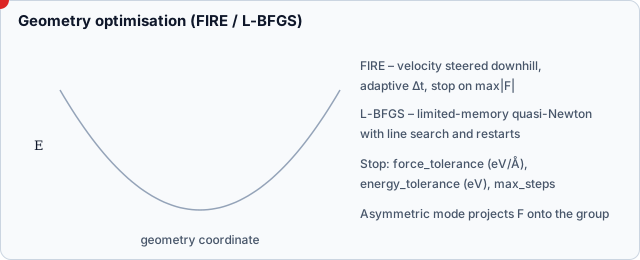
- FIRE (
Minimizer::Fire): molecular dynamics with the velocity steered downhill, an adaptive time step and a force criterion. - L-BFGS (
Minimizer::Lbfgs): a limited-memory quasi-Newton method with a line search and restarts.
Both stop on force_tolerance (eV/Angstrom), energy_tolerance (eV) or max_steps. OptimizationResult { structure, energy, max_force, steps, converged } is deterministic. apply_optimized_geometry writes the result back onto the original representation.
Constraints and scans
ScanCoordinate is a distance, an angle or a torsion between single atoms (P1 site indices, minimum image through the lattice). Groups of atoms with a centroid endpoint, the angle between planes and the cell parameters or volume as coordinates are not implemented. Constraint holds a coordinate while the rest relaxes by projecting its gradient out, rather than freezing the atoms that define it; OptimizeOptions.fixed_atoms freezes whole atoms.
relaxed_scan steps the coordinate, constrains it, relaxes everything else starting from the previous point, and returns ScanPoint { value, energy, structure, converged } for every value in memory. It does not write scan.csv or per-point files and cannot resume an interrupted scan; a caller that wants that writes each returned point itself. An invalid axis (non-P1 structure, empty values, a degenerate angle) is a typed error.
The optimizers take no cancellation token or progress callback and write no trajectory; they stop on force_tolerance, energy_tolerance or max_steps.
Equation of state
fit_eos(points, EosForm) fits energy-volume points with Birch-Murnaghan or Murnaghan and returns EosFit { v0, e0, b0, b0_prime, rms }. b0 is in eV per Angstrom cubed internally and converted to GPa at the boundary. The points normally come from a constant-volume scan in which the shape and atoms are free.