Formats and the registry
Registry
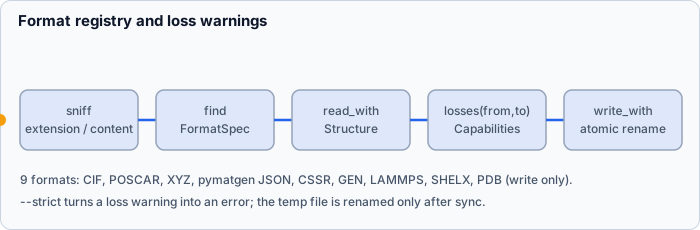
Every format is a FormatSpec { name, extensions, read, write, capabilities } in one table. find accepts a name or extension; read_with/write_with resolve it. sniff inspects the content when the extension is missing or misleading: CIF tags, a pymatgen @module JSON object, an XYZ atom-count line.
Loss warnings
Capabilities records cell, symmetry, occupancy, ADPs, charges, bonds, labels and frames. losses(from, to) names the differences; the CLI prints them and --strict turns them into an error. ExportPolicy controls the P1 expansion and the hydrogen, dummy and explicit-bond filters independently.
Atomic writes
A write creates a temporary file in the destination directory, writes, flushes, syncs and renames. A failure removes the temporary file; the previous target is never truncated. WASM has no filesystem and returns the string/bytes instead.
pymatgen JSON, CSSR and GEN
pymatgen JSON keeps the lattice matrix and per-site species/occupancy; the writer emits P1. CSSR and GEN are whole-cell formats and are also written in P1. CSSR's eight zero connectivity slots are kept so Zeo++ reads the charge column correctly. GEN is C (cluster), S (Cartesian supercell) or F (fractional supercell).
Grids and trajectories
Grid3 stores origin, three step vectors, shape and x-fastest data. Cube files use Bohr for the header and coordinates; a negative voxel count switches the step unit to Angstrom. XY patterns are two or three whitespace columns. Trajectory keeps elements and atom order fixed across frames; multi-frame extended XYZ carries Lattice, energy, step and arbitrary key/value info.
Trajectories
Extended XYZ is indexed by frame header: XyzIndex stores the byte offset, comment metadata, lattice and element sequence of each frame, then parses coordinates only when frame(i) or structure(i) asks for one. The element sequence is validated during the index pass, so a file that changes atom order between frames is refused before any frame is returned.
VASP XDATCAR is read as a fixed-cell trajectory: the positive scale multiplies the three lattice rows, the species/count lines expand the element sequence, and each Direct configuration= block supplies fractional coordinates. Cartesian configuration= is converted through the cell. A negative VASP scale (target volume) is refused rather than guessed.
LAMMPS text dumps are read frame by frame: ITEM: TIMESTEP, ITEM: NUMBER OF ATOMS, an orthogonal or triclinic ITEM: BOX BOUNDS (the xy/xz/yz tilt and the bound corrections are applied) and an ITEM: ATOMS table. Coordinates may be Cartesian (x/y/z, xu/yu/zu) or fractional (xs/ys/zs, xsu/ysu/zsu). The element comes from an element column or from a caller-supplied type map. DFTB+ geo_end.xyz is plain extended XYZ without a cell, so it is placed in one shared cubic box with 5 A of vacuum; geo_end.gen is a one-frame final geometry.