Lattice conventions and geometry
Problem
The unit cell is the coordinate system for every later operation. A single convention for rows, fractional coordinates and the reciprocal lattice prevents sign and transpose mistakes in P1 expansion, supercells, slabs, neighbours and force fields.
Conventions
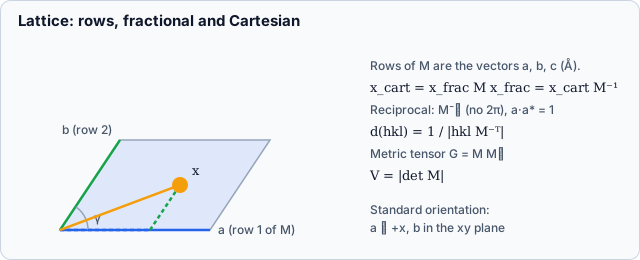
- The matrix rows are the vectors a, b, c in Angstrom.
- Fractional to Cartesian is
x_cart = x_frac M; the inverse isx_frac = x_cart M^-1. - The standard orientation puts a along +x and b in the xy plane:
a = (a, 0, 0),b = (b cos gamma, b sin gamma, 0),c = (c cos beta, c (cos alpha - cos beta cos gamma) / sin gamma, c z). - The reciprocal lattice is
M^-Twithout 2 pi, soa . a* = 1andd(hkl) = 1 / |hkl M^-T|. - The metric tensor is
G = M M^T;x G x^Tis a squared Cartesian length.
Validation
The cell must have finite entries and a non-zero determinant. Lengths are strictly positive and angles lie strictly between 0 and 180 degrees. The standard orientation is possible only when
z^2 = 1 - cos^2 beta - ((cos alpha - cos beta cos gamma) / sin gamma)^2 > 0.Otherwise the three angles cannot bound a parallelepiped and the constructor reports them.
Minimum image
For a fractional displacement d, the minimum-image vector is d - n for the integer vector n that minimizes |(d - n) M|. The implementation starts with n = round(d) and then enumerates every n that can improve the distance. The bound follows from x = y M^-1 and |x| <= |y| ||M^-1||_F:
|y| >= |x| / ||M^-1||_F.If the current best distance is r, any candidate with |d - n| > r ||M^-1||_F is farther away, so the box around d is complete. This is exact for skewed triclinic cells; the usual 27-image search is only a special case for well-reduced cells.
Worked triclinic example
a = 3, b = 4, c = 5, alpha = 60, beta = 70, gamma = 80:
M = [ 3.000000   0.000000   0.000000
      0.694593   3.939231   0.000000
      1.710101   2.237030   4.131737 ]
V = 48.827604 A^3
d(111) = 2.589161 A
The (111) normal is (0.863054, 0.505096, -0.004033), not the direction [111]; only an orthogonal cell makes the two agree.
Complexity
Construction and parameter queries are constant time. Fractional/Cartesian conversion is O(1) per point. The minimum-image search is O(k^3) in the number of integer shifts that can beat the initial distance; for ordinary cells k is 1 or 2, and the dynamic bound keeps pathological skews exact.
Validation data
tests/vectors/lattice.json contains cubic, hexagonal and triclinic cases. The Rust, CLI, Python and WASM tests all compare volumes and minimum-image distances against those vectors. Tolerances are in validation.md.