Vibrations, phonons and thermodynamics
Gamma-point Hessian
hessian(calculator, structure, &HessianOptions) displaces each Cartesian coordinate of the P1 cell by +step and -step, reads the analytic forces and forms the central-difference Hessian, symmetrised as (H + H^T)/2. The cost is 6N + 1 force evaluations. The structure must be P1; a dummy atom is rejected because it has no force-field parameters.
Modes
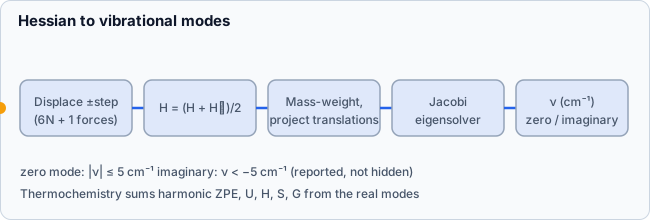
vibrational_modes(&hessian, structure, options) mass-weights the Hessian with the element masses, projects out the rigid translations (and the molecular rotations when DisplacementMode::Molecule is selected) and diagonalises the symmetric matrix with a deterministic Jacobi eigensolver. Frequencies are in cm^-1, ascending. A mode within ZERO_MODE_TOLERANCE_CM is a zero mode; a negative frequency below IMAGINARY_BELOW_CM is imaginary and is reported, not hidden.
VibrationalModes { frequencies, modes, zero_modes, imaginary } carries the normalised Cartesian displacement fields.
IR spectrum
ir_spectrum(structure, modes, &IrOptions) uses fixed QEq charges and a finite-difference dipole derivative with respect to each mode. The intensity is the squared dipole derivative in km/mol. The module states the approximation: Born effective charges are replaced by the fixed QEq charges, which is the same approximation Crystal-Builder documents. The sticks are broadened with a Gaussian or Lorentzian into IrSpectrum { points, peaks }.
Phonons
phonons with q_grid = [1, 1, 1] and supercell = [1, 1, 1] uses the primitive-cell Hessian. Any other grid builds the supercell, takes the finite-difference Hessian there, folds the force constants onto the primitive cell with the shortest periodic image, applies the acoustic sum rule and diagonalizes the mass-weighted dynamical matrix at every Monkhorst-Pack point. The grid q-points are (n + 1/2) / N - 1/2 per axis, in fractional reciprocal coordinates; an explicit q_path replaces the grid, which is how the Task 2.10 band path is sampled. The optional DOS is a Gaussian-smeared histogram normalized to unit area.
A fcc argon crystal with UFF (crates/xtalforge-ff/tests/phonon_argon.rs) checks the physics: three zero acoustic modes at Gamma, a degenerate transverse pair below the longitudinal mode at L (27.3, 27.3 and 60.0 cm^-1), LA/TA = 1.45 at X, and positive increasing branches for small q.
The Gamma path remains the acoustic reference. The q-mesh path is validated against the analytic dispersion of a nearest-neighbour spring model and against a phonopy-generated golden file (tests/golden/phase-4/phonons/spring-sc.json) for the same model; the generator is scripts/golden/phonons_spring.py.
Thermochemistry
thermochemistry(frequencies, &ThermoOptions) sums the harmonic oscillator contributions: zero-point energy, thermal U and H, entropy and Gibbs energy at a temperature. ideal_gas_thermochemistry adds the translational and rigid-rotor terms at a pressure. Imaginary, zero and non-finite modes do not enter the partition function; the caller sees them in the mode result.
Quasi-harmonic free energy
quasi_harmonic_free_energy(points, options) evaluates F(V, T) = E(V) + F_vib(V, T) at each supplied volume. With three or more points the lowest sampled value is refined by a parabola through its neighbours. The result carries the points and the refined minimum. Thermal expansion and bulk modulus versus temperature are not yet derived.