Periodic neighbor search
The search combines a linked-cell index with exact image enumeration. It returns every contact within the cutoff once per lattice image, including the self-images of a small cell.
Linked-cell index
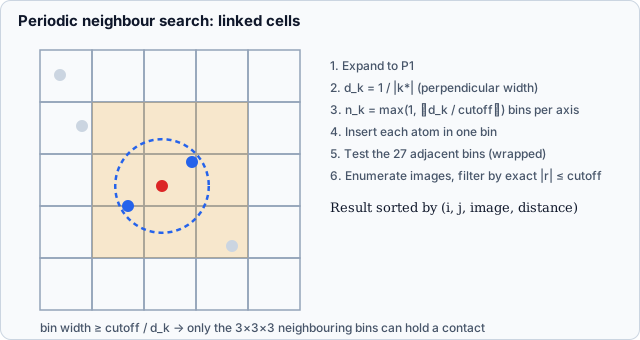
- The structure is expanded to P1.
- The perpendicular width of each axis comes from the reciprocal cell:
d_k = 1 / |k*|. Edge lengths are not enough for a skewed cell. - Each axis is divided into
n_k = max(1, floor(d_k / cutoff))bins in fractional coordinates. A pair withincutoffsatisfies|delta x_k| <= cutoff / d_k <= 1 / n_k, so it always falls in the same or an adjacent bin, wraps included. - Each atom is inserted into one bin. Candidate pairs come from the 27 neighbouring bins (deduplicated when an axis has one or two bins).
- For every candidate pair the integer images that can reach the cutoff are enumerated per axis, and the exact Cartesian distance filters the result.
Self-images (i == j, nonzero image) are included; the zero image is not. When the cutoff is at least one perpendicular width the index degenerates to one bin and the search is quadratic, which is the only case where this happens.
Determinism
Results are sorted by (i, j, image, distance); the order does not depend on hash-map iteration or platform. The same structure and cutoff return the same list on every surface.
Benchmarks
The table compares the Rust search with the Crystal-Builder Python implementation (xtal.core.neighbors.neighbor_pairs, scipy cKDTree) on the same coordinates: a cubic cell at 0.05 atoms/Angstrom^3, cutoff 3.0 Angstrom, median of five Rust runs and three Python runs. Rust is a release build; Python is 3.14.4 with numpy 2.4.4 and scipy 1.17.1 on the same Linux x86-64 machine.
| Atoms | Rust | Python | Neighbors |
|---|---|---|---|
| 1,000 | 2.9 ms | 10.2 ms | 2,838 |
| 10,000 | 44.1 ms | 133.1 ms | 28,409 |
| 100,000 | 845.4 ms | 3,563.1 ms | 282,450 |
The Rust side is reproducible with:
cargo bench -p xtalforge-core --bench neighborsThe P1 expansion that every query performs also uses a fractional grid for duplicate detection, so its cost is linear in the number of generated atoms instead of the previous quadratic scan.