Builders: molecules, polymers, carbon and nets
Reference: Crystal-Builder xtal/build/ and sci-form smiles.rs (MIT). The builders produce P1 structures with explicit bonds; they do not infer a space group.
SMILES and 3D embedding
parse_smiles builds the graph (atoms, bonds, aromatic flags, charges) and embed_smiles places it in 3D. The embedder is a small distance-geometry relaxation, not ETKDG: the atoms start on a seeded Fibonacci spiral and a gradient descent drives three terms, bond lengths towards element-pair values, 1-3 distances towards the ideal bond angle of the shared atom (180 degrees for a triple bond or cumulated double bonds, 120 degrees for an aromatic or double-bonded atom, 109.47 degrees otherwise; three- and four-membered rings keep only their bonds) and a non-bonded repulsion. The same SMILES and seed give the same coordinates; the seed is an argument, never a hidden global. Benzene, naphthalene, cyclohexane, neopentane and propyne are checked for their bond lengths and angles in crates/xtalforge-build/tests/embed.rs. Before the 2026-11-11 audit the angle term was missing and rings collapsed (benzene had 1.17 Angstrom 1-3 contacts).
Aromatic rings use the pyykko aromatic radius; the parser records the Kekulé form so a writer can round-trip it. Unknown elements and malformed ring closures are typed errors.
Fragments and substitution
The fragment library is a name, SMILES, category and description. A fragment is embedded on demand. clearance reports the shortest distance from a point to the existing atoms, and substitute replaces a site while keeping the occupancy, label and charge metadata. A substitution that would overlap an atom is refused unless the caller passes the documented override.
Hydrogens
add_hydrogens reads the perceived bond graph, compares each C/N/O/B/P/S atom with its target valence and places the missing H along the free directions. Directions are computed through the lattice minimum image, so a hydrogen on a cell boundary is not duplicated. Element defaults are C-H 1.09, N-H 1.01 and O-H 0.96 A; setting any other distance uses it for every element.
The function assumes the bond rules are right: a wrong perception gives wrong hydrogens. The diagnostics page lists missing_hydrogens as the signal that this step is needed.
Polymers
build_polymer(smiles, monomers, density) embeds one repeat unit and rotates it so that the first SMILES atom (the head) and the last one (the tail) lie on the a axis. The units are joined head to tail, each tail bonded to the next head at the sum of their covalent radii, and the last unit bonds to the first through the periodic boundary, so the chain is infinite along a. The cell is orthorhombic: a is the chain period and the square cross-section gives the target density from the real atomic masses. If that cross-section would bring the chain within 2.5 Angstrom of its periodic image the cell is widened and the achieved density is reported in the steps. Write the backbone first and last (C(c1ccccc1)C for polystyrene); hydrogens are not added, run add_hydrogens afterwards. Before the 2026-11-11 audit the chain was packed into a cube smaller than its own length, which overlapped carbons at 0.67 Angstrom.
Carbon allotropes
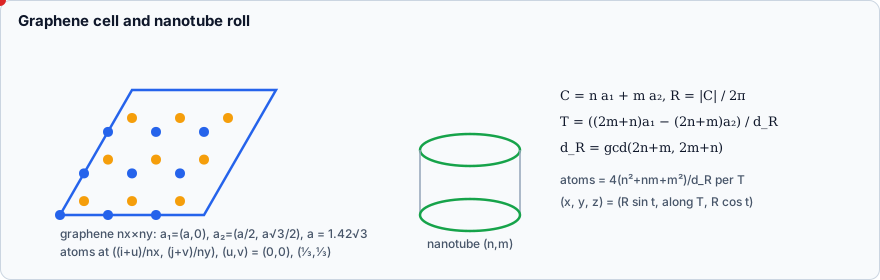
graphene(nx, ny, layers, interlayer, vacuum)is an AA-stacked honeycomb sheet. The cell isnx a1andny a2witha1 = (a, 0),a2 = (a/2, a sqrt(3)/2)anda = 1.42 sqrt(3); the two atoms of primitive cell(i, j)sit at fractional((i + u)/nx, (j + v)/ny)with(u, v) = (0, 0)and(1/3, 1/3). Every bond is 1.42 Angstrom.nanotube(n, m, length, vacuum)rolls the honeycomb along the chiral vectorC = n a1 + m a2. The strip is|C|wide andlengthtranslation vectorsT = ((2m + n) a1 - (2n + m) a2) / d_Rlong, withd_R = gcd(2n + m, 2m + n), and holds4 (n^2 + n m + m^2) / d_Ratoms perT. Each atom goes to(R sin t, y, R cos t)withR = |C| / 2 piandt = 2 pi (r . C) / |C|^2, in a cell2R + vacuumwide on x and z with the axis along y; the bonds are chords, about 1 % shorter than 1.42 Angstrom for a narrow tube.fullerene(60)uses the built-in C60 coordinates;face_spiral(20)gives C20 by a documented face traversal.commensurate_twist(n, m, theta, layers)builds a twisted multilayer in the commensurate moire cellL1 = i a1 + j a2,L2 = R(60) L1, whose twist obeyscos theta = (i^2 + 4ij + j^2) / (2 (i^2 + ij + j^2))and which holds2 (i^2 + ij + j^2)atoms per layer. The smallest cell within 0.05 degrees of the request is chosen (indices up to 20), otherwise the closest angle;n x mis the in-plane repeat of the moire cell. Even layers keep the reference orientation, odd layers are rotated, 3.35 Angstrom apart.(2, 1)gives 21.787 degrees and 14 atoms per layer. Before the 2026-11-11 audit the angle was rounded to 0 or 60 degrees.nanoribbon(width, length, vacuum)is a honeycomb strip periodic alonga; thebvector grows byvacuumwhile the atoms keep their Cartesian positions.build_ztc/build_schwarzitesample the gyroid or Schwarz P level set on a periodic grid of about 1.2 Angstrom (including the closing plane, and nudging samples that sit exactly on the isovalue), weld the marching tetrahedra mesh, remesh it towards 2.459 Angstrom edges (the dual of a 1.42 Angstrom honeycomb), place one carbon per triangle and relax the dual graph to 1.42 Angstrom bonds and 120 degree angles. For cells of 12 Angstrom and above at least 97 % of the carbons are three-coordinate, with 5-, 6-, 7- and 8-membered rings as in real schwarzites. Before the 2026-11-11 audit the carbons were the mesh vertices thinned to 1 Angstrom (coordination 5-8) and the sampled grid lacked the closing plane, which left an open seam on the cell faces.build_carbonis the disordered recipe documented in carbon.
Nets and guests
build_net turns a CGD entry into a P1 structure whose sites are vertices and whose topology bonds are edges. place_guest puts a molecule into a pore with a clearance check. Interpenetration is a separate command over a document.
Validation
crates/xtalforge-build/tests/covers SMILES round-trips, embedding determinism, fragment lookup, hydrogen counts, polymer density, C20/C60 vertex and face counts, graphene/nanotube ring census, twist/ribbon periodicity and the carbon golden data.- The C60 coordinates are a recorded data file, not a generated geometry; the test checks 60 vertices and 90 edges.
- The carbon recipe is validated against the Crystal-Builder distributions in
tests/golden/phase-6/carbon/, with the documented remesh/ribbon deviations.
Differences from Crystal-Builder
- The embedder is deterministic from a seed; the reference may use a random initialisation.
- A substitution overlap is refused rather than warned.
- The polymer builder reports the achieved density; it does not silently continue when the target is out of range.