MOF builder
Reference: PORMAKE 0.2.3 as vendored in Crystal-Builder (MIT). The crate keeps the algorithm shape but ships a curated topology/block subset; it is not the full PORMAKE database.
Data model
- Topology: a finite periodic quotient. Nodes are fractional coordinates in a cell
[a, b, c, alpha, beta, gamma]; edges are undirected index pairs. - Block: a small molecule in Cartesian Angstrom with an origin and outward connection-point vectors. A block is a node or a linker; its
cellmatrix is a display bounding box, not a placement cell. - Build: copy a node to every topology vertex, orient it, place a linker on every edge, then scale the result.
Node orientation
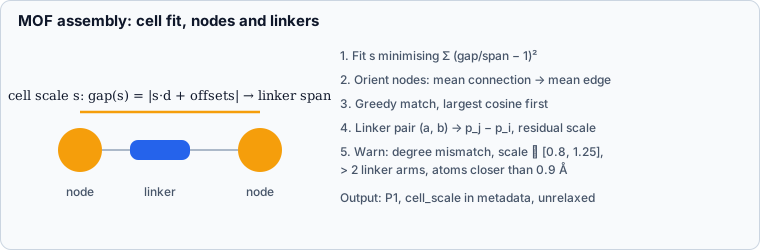
PORMAKE fits the connection directions to a slot by RMSD over all rotations. This port does the same with a Kabsch fit (xtalforge-mof/src/align.rs): when the vertex degree equals the node's connection count (at most six), every one-to-one assignment of connection points to incident edges is tried, the proper rotation that best maps the unit connection directions onto the unit edge directions is computed with Horn's quaternion method, and the assignment with the smallest residual wins (ties keep the first permutation, so the result is deterministic). Rotation entries within 1e-9 of -1, 0 or 1 are snapped.
When the degree differs from the connection count, the earlier greedy rule is kept as the fallback:
- Local reference = normalised mean of the node connection vectors. If that mean is zero (octahedral or trigonal), use the lowest-index connection.
- Target = normalised mean of the incident edge directions; if zero, use the lowest-index edge.
- Rotation = minimal proper rotation between those directions.
- Greedy matching: the connection/edge pair with the largest cosine is assigned first; ties use the index order.
Before the 2026-11-11 audit only the greedy rule existed. It left the in-plane angle of a planar node arbitrary, so in srs the benzene linker had to be scaled from 0.55 to 1.26 times its length; with the Kabsch fit the linkers stay within the 0.8-1.25 band.
Cell scale and linker placement
The catalogue cell of a topology fixes the node-to-node distances, but the linker decides how long an edge has to be. Before placing anything the builder therefore scales the whole cell uniformly by the factor s that minimises sum_edges (gap_e(s) / span - 1)^2, where gap_e(s) = |s d_e + (R_j p_j - R_i p_i)| is the distance the linker has to bridge between the two oriented node connection points (d_e is the unscaled node-to-node vector) and span is the largest distance between two connection points of the linker. The search is a golden-section on [0.1, 20] and is deterministic; the factor is stored in the structure metadata as cell_scale. A longer linker (stilbene instead of benzene in pcu) therefore gives a larger cell instead of a squashed linker.
For each edge i-j the linker pair (a, b) with the largest separation is then aligned to p_j - p_i, translated so a lands on p_i, and scaled by gap_e / span. After the fit that residual scale is close to one when every edge of the topology has the same length. When it is not (for example srs with a paddlewheel), the builder records one warning if the scales fall outside [0.8, 1.25] (LINKER_SCALE_MIN, LINKER_SCALE_MAX); the scale is still applied, so the warning is the signal that the linker is distorted.
Assembly
build_mof returns a P1 structure with the node and linker atoms, explicit topology bonds and metadata naming the topology, the blocks and the cell_scale, plus the list of warnings. It does not relax the geometry. Interpenetration, if requested, is a separate operation over the assembled document.
The advanced subset adds rods, layers, merged nets, decoration and invented linkers. Each is a geometric construction with its own documented limitations; the pore partition reports the accessible volume per framework rather than claiming a topology assignment.
Validation
crates/xtalforge-mof/tests/mof.rschecks every curated block's connection count and span, every topology's edge/node consistency, a build for each topology, determinism, and that a bad block name or a scale out of range is a typed error.crates/xtalforge-mof/tests/advanced.rscovers rods, layers, merged nets and decoration.- The builder is not validated against PORMAKE's full output; the subset is illustrative and the test records that.
Differences from PORMAKE
- Curated topology and block subset, not the full database.
- Greedy deterministic orientation instead of a global RMSD fit.
- The result is P1 and unrelaxed; there is no automatic symmetry assignment.
- A node whose connection count differs from the vertex degree is not refused: the edges without a connection point are skipped and one warning names the number of vertices affected. A linker with more than two connection points spans each edge with its widest pair and is reported.
- A final check lists atom pairs closer than 0.9 Angstrom (
CLOSE_CONTACT) in one warning; every combination of the curated blocks builds, and the combinations that do not fit chemically carry at least one of these warnings.