Powder pipeline: instrument, profiles and the automatic run
The individual fits have their own pages: indexing, Le Bail, Pawley, Rietveld and extinction screening. This page covers the parts that connect them.
Instrument and profile
Instrument holds the geometry (BraggBrentano or DebyeScherrer), the zero shift, the specimen displacement s (mm), the goniometer radius R (mm, default 240), the K alpha2 / K alpha1 intensity ratio (default 0.5) and a polarisation fraction. Two aberrations move a line from its Bragg position:
2 theta_reported = 2 theta_nominal + zero_shift
delta(2 theta)   = -2 s cos(theta) / R          (Bragg-Brentano only)
A positive displacement moves the line to a lower angle; the capillary geometry has no displacement term. A doublet (doublet, doublet_checked) places the K alpha2 line by Bragg's law from the K alpha1 position at the intensity ratio. The polarisation field is stored and validated but the PXRD profile applies its own Lorentz-polarisation factor and does not read it yet.
ProfileKind selects Gaussian, Lorentzian or pseudo-Voigt (eta L + (1 - eta) G, eta clamped to [0, 1]). The calculated PXRD pattern uses one Gaussian of the requested FWHM for every reflection; a Caglioti width (U, V, W) is not implemented. Le Bail and Pawley default to pseudo-Voigt. The model is explicit: no axial divergence, specimen transparency or receiving-slit correction, and no size/strain broadening beyond the width parameters of the fits.
Cells and extinction
free_cell_parameters returns the parameters a crystal system lets vary; free_cell_parameters_with_setting adds the setting (unique axis, origin choice). extinction_symbol and space_group_candidates enumerate the groups compatible with the observed absences. The ranking described on the extinction page uses a Le Bail BIC and a Pawley fit per leading class; the 1 % Rwp tie rule orders the table.
Automatic run
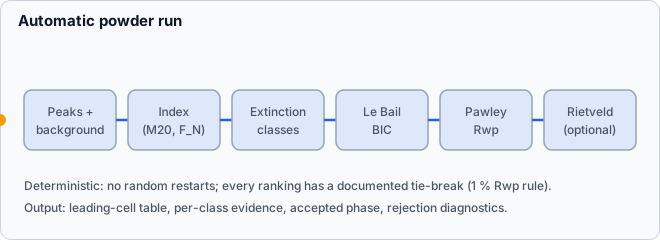
run_automatic is the orchestrator:
- find peaks: subtract a SNIP background (window 40 points), keep the lines above 1 % of the strongest and above five times the noise (median absolute deviation of the background-free signal), smoothed once, at most
max_peaks(default 30) strongest; - index the peak list and keep the leading cells;
- for each leading cell, enumerate the extinction classes;
- Le Bail every (cell, class), score by BIC;
- Pawley-fit every leading pair and rank by Rwp with the tie rule;
- optionally refine the best phase with Rietveld.
The result carries the leading-cell table, the per-class evidence, the accepted phase and the diagnostics that explain a rejection. It is deterministic: no random restarts, and every ranking has a documented tie-break.
Rietx bridge
rietx_inventory reports whether the optional Python rietx package is available and what it provides. The bridge is an inventory and acceptance check, not a hidden subprocess: a caller decides to run it. The license note is kept with the bridge.
Acceptance
check_acceptance compares a refinement with the reference tolerances: maximum Rwp and maximum position error. A run that exceeds them is reported as rejected with the metric that failed. The thresholds are constants in the crate, not a command-line default.
Validation
- Golden indexing, Le Bail, Pawley and Rietveld data are in
tests/golden/phase-7/; the rutile pattern comes from Crystal-Builder and rietx. - The automatic table golden checks the class ranking and the leading cell.
- The extinction golden checks the partition and the leading rutile class.
- The CoRE MOF subset checks that a real framework yields a bounded pattern; it is not a refinement reference.