Extinction screening
What it decides
An indexed pattern fixes a cell and a metric family, but not the space group: the same cell is compatible with several groups whose general positions make different reflections systematically absent. space_group_candidates(system, hkl) rejects every group that would make an observed indexed reflection impossible; extinction_classes(system, hkl) groups the survivors by their full reflection-condition signature so the automatic run can fit one representative per class.
Structure-factor test
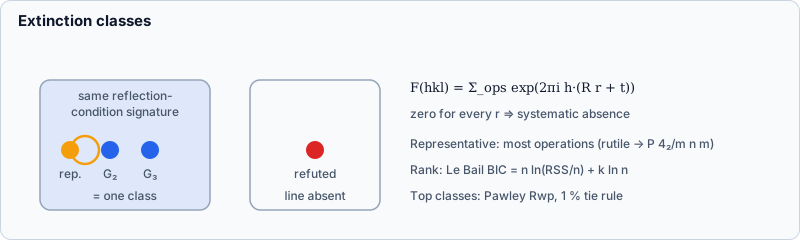
For a group with operations (R, t) in the conventional cell, the structure factor of a single atom on a general position r is
F(hkl) = sum over operations of exp(2 pi i h . (R r + t))This sum is zero for every r exactly when the reflection is systematically absent. Two generic fractional points are evaluated; their normalised |F| are below 1e-6 when the group cancels the reflection. The operations include the centering translations, so the Bravais absences (F, I, C, R) come out of the same sum as the glide and screw absences.
is_systematically_absent(operations, hkl) is the public form of that test. space_group_candidates enumerates the catalogue for the cell's crystal system (trigonal groups are included for a hexagonal cell), keeps the first Hall setting of each ITA number, counts the indexed reflections each group forbids and returns the groups with the fewest violations (zero when a group is perfect). MAX_CANDIDATES limits the list; the ranking is by number of operations, so the highest-symmetry compatible group comes first.
Extinction classes
A powder pattern shows the extinction symbol; the groups that share it differ only by elements that produce no absence. extinction_classes(system, hkl) enumerates the catalogue groups of the cell's crystal system, computes each group's reflection-condition signature over a fixed hkl grid, and merges the groups with the same signature. The representative is the group with the most operations (rutile's class is represented by P 4_2/m n m, not by one of its subgroups). A class is refuted when any observed indexed reflection is systematically absent in it.
Ranking
The automatic run ranks the surviving classes by a Le Bail fit of a structure with one general-position atom in the class's representative group:
BIC = n ln(RSS / n) + k ln(n), delta_BIC = BIC_class - BIC_lattice,with RSS the weighted residual sum of the Le Bail profile, k the number of extracted reflections plus the scale and background terms, and the lattice class the absence-free class of the same cell. The leading classes are then Pawley fitted; the table is ordered by Pawley Rwp, with fits within 1 % of each other treated as a tie and ordered by the indexing and class ranks.
The class symbol in the row is the representative's Hermann-Mauguin symbol (not the standard extinction symbol); its space_groups list names every group in the class.
Validation
crates/xtalforge-analysis/tests/extinction.rs checks:
- rutile
P4_2/mnm(136) is the first row of the golden rutile table, and an impossible001removes it from the candidates; - diamond
Fd-3m(227) is among the candidates of a diamond pattern, and an impossible200removes it; - the class enumeration of rutile puts 136 in the
P 4_2/m n mclass and the golden automatic table selects it first; - the reflection conditions of 136 and 227 match the values computed from their operations:
00leven, even index sums for the rutile glide planes, theFd-3mdiamond-glide conditions, and the fact that 222 is allowed by theFd-3mgeneral position (its absence in diamond is a special-position effect of the 8a site).
tests/automatic.rs runs the whole automatic pipeline on a rutile pattern and requires the table to contain the space-group candidates.