CIF parsing
Pipeline
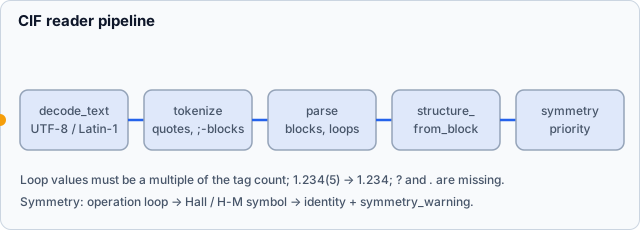
decode_textstrips a UTF-8 BOM, reads UTF-8 and falls back to Latin-1.- The tokenizer walks lines, removes comments outside quotes, keeps quoted values together and collects semicolon-delimited text blocks.
- The parser builds data blocks, single items and loops. Loop values must be a multiple of the tag count.
structure_from_blockreads the cell, Hall/H-M symbol, symmetry-operation loop, atom sites, occupancy, Uiso/Uij, charge, disorder group/assembly and the program's explicit-bond loop, and builds aStructure.
Symmetry priority
The operation loop is the setting when present. Without a loop, the reader resolves the Hall symbol (or H-M symbol) through xtalforge_symmetry::SpaceGroup::parse and installs its operations, recording symmetry_source = "Hall symbol". Only an unrecognised symbol falls back to the identity and records a symmetry_warning. This closes the common CIF case where the space group is named but the operation loop is omitted (graphene is the corpus example). When both an operation loop and a symbol are present, the reader compares the full operation set (rotation and translation modulo one) with the named group. A count or set disagreement records a symmetry_warning.
Numbers
1.234(5) is read as 1.234; ? and . become missing values. Malformed numbers or truncated loops return Error::InvalidInput, never a panic. A fuzz-style regression test feeds empty, truncated and mismatched inputs.
Disorder and anisotropic parameters
_atom_site_disorder_group becomes Site::disorder_group; a non-numeric group and _atom_site_disorder_assembly are kept in Site::props so a save does not drop them. The anisotropic loop is matched by _atom_site_aniso_label, not by row position, so a file that refines only some atoms still reads correctly.
Explicit bonds
A _geom_bond loop is read only when it carries _xtal_bond_kind, the tag this program writes. Published _geom_bond loops are usually distance tables from a refinement, not a bond graph, and reading them silently would override perception. The row names sites by label, carries the lattice image and order, and suppressed removes a perceived bond. The writer emits the loop for P1 structures.
For a non-P1 structure the row's _geom_bond_site_symmetry_2 code is the operation number plus a three-digit translation offset, and the reader maps label + operation + image through every symmetry operation to P1 contacts. The duplicate images of a special-position pair are collapsed by their minimum-image contact vector. MIL53 maps its two records to the 36 golden contacts. An unmatched mapped record does not invent a graph edge: only a contact perception already found is annotated, because the P1 representative is the one the graph is drawn with.
The writer round-trips a non-P1 explicit set with _xtal_bond_p1_count and the _xtal_bond_atom_1/_xtal_bond_atom_2 index loop (plus image, order and kind). The reader validates the declared P1 count against its own expansion before accepting the indices. The label/operation loop remains the readable form for P1; both are understood on input.
Writer
write_cif writes the cell, Hall symbol, operation loop, sites, occupancy, Uiso, Uij, disorder group/assembly, charge and the explicit-bond loop. The round-trip tests read the written structure back.