Charges and electrostatics
QEq
qeq_charges(structure, &ChargeOptions) solves the Rappé-Goddard charge equilibration. Each element contributes an electronegativity chi and a hardness J; the energy is sum_i (chi_i Q_i + J_i Q_i^2 / 2) + sum_{i<j} J_ij Q_i Q_j with the Ohno-Klopman kernel J_ij = 14.4 / sqrt(r^2 + (14.4 / sqrt(J_i J_j))^2) (eV, Angstrom). It uses the hardnesses only, not the UFF bond radii. The total charge is enforced by a Lagrange multiplier (one KKT system).
The linear system is solved on the P1 cell with a real-space cutoff (default 12 Angstrom, summed over every image inside it, with no Ewald correction). The truncated sum under-polarises ionic solids: NaCl comes out near +-0.20, not +-1, so use QEq for molecules and frameworks, and EQeq or an explicit charge set for ionic crystals; the result is Charges { per_atom, total }. apply_to writes the per-site mean over the images back to the asymmetric unit.
EQeq
eqeq_charges keeps the same solver and replaces the parameters with measured ionisation energies and electron affinities (Wilmer, Kim and Snurr 2012), expanded about each element's usual charge centre. A dielectric of 1.2 is the reference default. This is the variant that keeps framework metals from running away from the neutral-atom parabola.
EEQ
eeq_charges is EEQ2019 (Caldeweyher et al., J. Chem. Phys. 150, 154122, 2019), ported from sci-form src/charges_eeq/eeq2019.rs with the grimme-lab/multicharge parameters for H to Lr (crates/xtalforge-ff/data/ eeq2019.json). In atomic units it solves
A_ii = eta_i + sqrt(2/pi) / rad_i
A_ij = sum_images erf(r / sqrt(rad_i^2 + rad_j^2)) / (eps r)
x_i  = -chi_i + kcn_i sqrt(CN_i),   A q = x,   sum q = Q
with an erf-counted coordination number (D3 covalent radii, smooth cap at 8, images within 25 Bohr). Coulomb images are summed inside options.cutoff, the same real-space rule as QEq; dielectric = 1 is plain EEQ2019. For isolated water and methanol the charges match sci-form (validated against dftd4) to 2e-3 (eeq2019_matches_the_sci_form_reference). Before the 2026-11-11 audit this function reused the QEq table and returned exactly the QEq charges.
Ewald
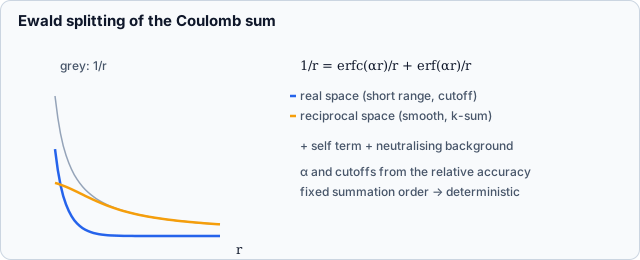
ewald_energy_forces(structure, &charges, &EwaldOptions) splits the Coulomb sum into a real-space part, a reciprocal-space part, a self term and a neutralising background. The splitting parameter and the cutoffs come from the requested relative accuracy; the summation order is fixed, so the energy is deterministic. Forces are the analytic derivative; the test compares them with finite differences and the energy with a spherical direct sum.
When to use which
- QEq: fast, neutral organic molecules and a first guess.
- EQeq: frameworks with metals, where measured ionisation energies matter.
- EEQ: EEQ2019 with periodic images in real space (no Ewald sum).
- Ewald: the periodic electrostatic energy and forces on top of any charge model.