Le Bail intensity extraction
Iteration
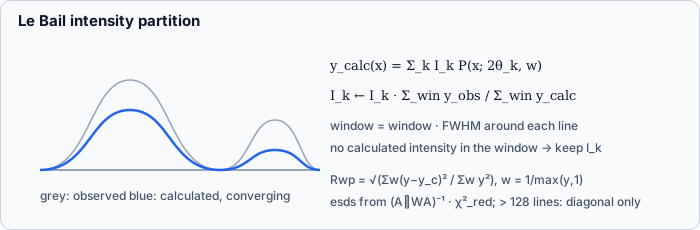
Le Bail extraction partitions the observed counts among the allowed reflections without a structural model. Starting from the PXRD reflection intensities I_k^0, each pass rebuilds the calculated pattern
y_calc(x) = sum_k I_k P(x; 2theta_k, w)and updates every intensity with the observed-to-calculated ratio inside its own window:
I_k <- I_k * sum_window y_obs / sum_window y_calcThe window is window * fwhm degrees around the reflection. A window with no calculated intensity keeps the previous value. After the requested passes the final profile sum becomes LebailResult::pattern and the last update the reported intensities.
R-factors
Rp = sum |y_obs - y_calc| / sum |y_obs|Rwp = sqrt(sum w (y_obs - y_calc)^2 / sum w y_obs^2)chi^2 = sum w (y_obs - y_calc)^2 / (N_obs - N_reflections)
with w = 1 / max(y_obs, 1).
Intensity esds
At the final intensities the profile design matrix A is assembled over the observed points, A[i][k] = P(x_i; 2theta_k, w), and the normal matrix is A^T W A. Its inverse scaled by the reduced chi-squared gives the covariance; the diagonal is intensity_esds. Reflections that overlap share covariance terms, so a weak line next to a strong one receives a larger esd than the diagonal approximation would suggest. Above 128 reflections the exact inverse is skipped and only variance / (A^T W A)_kk is used, which is documented as the diagonal approximation.
The esds describe the precision of the partition at the fixed cell, positions and profile. They do not include the uncertainty of those parameters; a Pawley fit with the cell and width free is the tool for that (see Pawley fit).
Validation
tests/lebail.rs generates a noisy silicon pattern from the PXRD reflections with a deterministic Poisson-like noise, runs Le Bail with the matching Gaussian profile, and requires at least 90% of the recovered intensities to be within four esds of the generating values. The other tests check the R-factors, the esd length and positivity, and the input validation.
Limits
- The profile is evaluated per reflection with one FWHM; size/strain broadening belongs to the Pawley and Rietveld stages.
- A reflection whose window contains no calculated intensity cannot be updated in that pass; the iteration keeps its previous value.
- The result is a partition, not a least-squares solution: the esds are the covariance of that partition, and overlapping reflections are correlated.