Nets and RCSR identification
Quotient graph
A periodic net is stored as a quotient graph: nodes are fractional vertices, edges carry the lattice shift of the second endpoint, and the labels are only decoration. components finds disconnected pieces and interpenetrate duplicates a graph at a shift. The CGD reader accepts both dialects of the RCSR file: an edge as a pair of points, or as a node label followed by one neighbour position. The file gives the asymmetric unit; a CGD entry read here must already be the quotient cell (or a P1 entry), since space-group expansion is a separate step not performed by quotient_graph.
Fingerprint
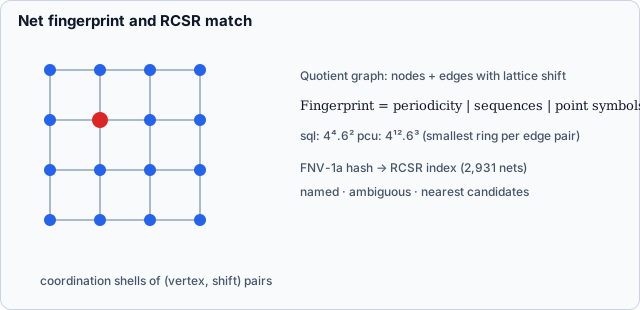
NetFingerprint is:
- the periodicity: the integer rank of the lattice the net's own cycles generate (spanning-forest voltages, not the width of the cell),
- the distinct coordination sequences to ten shells, computed over
(vertex, lattice shift)pairs so a six-neighbour vertex in a one-vertex cell counts six different atoms, - the distinct point symbols: for every pair of edges at a vertex, the smallest ring through that angle, with its multiplicity (
4^12.6^3forpcu). A ring longer than twelve is written*.
The token is periodicity|sequences|symbols, the form the RCSR index is built on. QuotientGraph::from_canonical_key parses the RCSR canonical key (d:n:a,b,sx,sy,sz;...) back into one minimal cell, which is how the index is validated.
RCSR catalogue
crates/xtalforge-analysis/data/rcsr_index.bin holds a 35 KB FNV-1a hash per catalogue entry: the periodicity, the distinct coordination numbers and the fingerprint hash, for all 2,931 nets of the 2019-06-01 snapshot. The full snapshots and their checksums live in data/rcsr/ at the repository root.
RcsrIndex::from_embedded() reads the index and identify computes the input fingerprint:
- one name with the same hash is
named, - several names are
ambiguous(they share both invariants), - no name gives the
nearestcandidates with the same periodicity and coordination numbers.
The reference names 2,665 of the 2,679 three-periodic nets uniquely this way. The index contains 35 shared fingerprint hashes (including 2D and polyhedral entries); the corresponding names are all returned rather than one being chosen silently.
Validation
examples/build_rcsr_index.rs rebuilds every keyed entry from its canonical key, computes the fingerprint and compares it with the stored coordination sequences and point symbols. The committed index reports 2,909 keyed entries, 22 unkeyed entries and no mismatch; the unkeyed entries are taken from the stored fingerprint because their canonical key is absent.
tests/rcsr.rs identifies tbo, pcu, fcu, sod, msf, srs, dia and sql from their canonical keys and checks an unknown graph. tests/cgd.rs reads the bundled snapshot (2,931 entries, one known incomplete block, moo-a) and both edge dialects.
Documented deviations
- Canonical keys are consumed from the RCSR JSON when the index is built, but an input graph's key is not recomputed; nets that share both invariants are reported as an ambiguous set.
- Space-group expansion of a CGD entry is not implemented; the reader accepts the expanded quotient cell and the
P1form. - The 22 unkeyed catalogue entries and the two-periodic/zero-periodic entries are matched by the stored fingerprint, not by a rebuilt graph.